
Hyundai Tucson Hybrid Drive Modes Explained: What Each One Does and Which I Actually Use
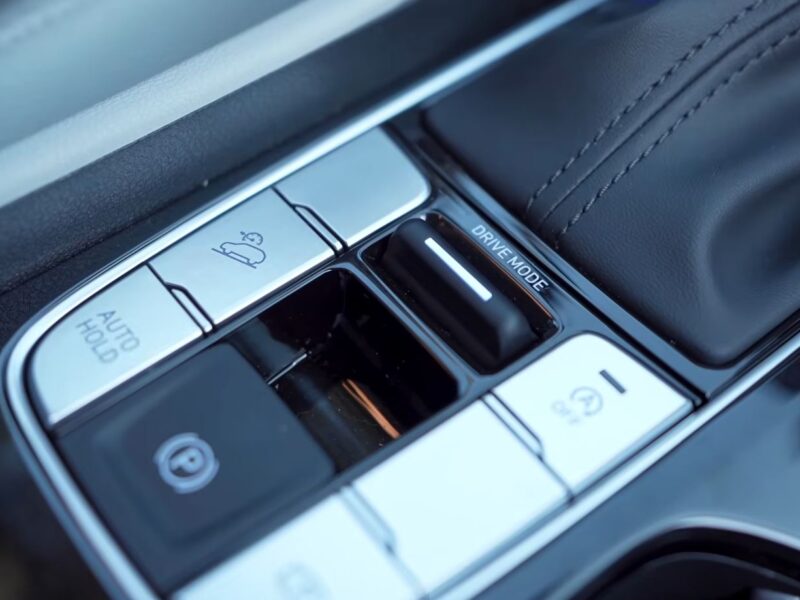
That little Drive Mode button changes more than the color of your dash.
But it changes less than most people think.
By the end of this guide, you’ll know what every mode on your Tucson Hybrid really does, which ones are worth using, and which ones you can mostly ignore.
I’ll also cover the stuff people think is a drive mode but isn’t, like the green EV light, Utility mode, and the plug-in’s EV/HEV button.
First, Which Modes Does Your Tucson Hybrid Have?
This is where a lot of confusion starts. Hyundai has shuffled the mode names around since the current generation (called NX4) launched for 2022. The 2025 refresh changed the cabin layout and added options.
Here’s my best compiled reference. Always confirm against the owner’s manual for your exact year and trim, because Hyundai’s US, UK and Australian cars don’t always match.
| Model year | Powertrain | Drive Mode button | AWD terrain modes |
|---|---|---|---|
| 2022-2024 | Hybrid (HEV), 1.6L turbo + electric motor | Eco, Sport, Smart | Snow, Mud, Sand |
| 2022-2024 | Plug-in Hybrid (PHEV) | Eco, Sport, Smart | Snow, Mud, Sand |
| 2025-2026 | Hybrid (HEV), refreshed | Eco, Sport, Smart, My Drive | Snow, Mud, Sand |
| 2025-2026 | Plug-in Hybrid (PHEV), refreshed | Eco, Sport, My Drive | Snow, Mud, Sand |
Not sure which modes you have? Press the Drive Mode button once and watch the instrument cluster. It cycles through everything available, and the screen theme changes with each one.
US-market Tucson Hybrids come with HTRAC all-wheel drive as standard, according to Hyundai’s US spec pages.
That’s why terrain modes show up on nearly every US hybrid. The front-drive hybrids you’ll see in owner forums (like the “Elite 2WD” in Australia) usually skip them.
Wait, Where Did Normal Mode Go?
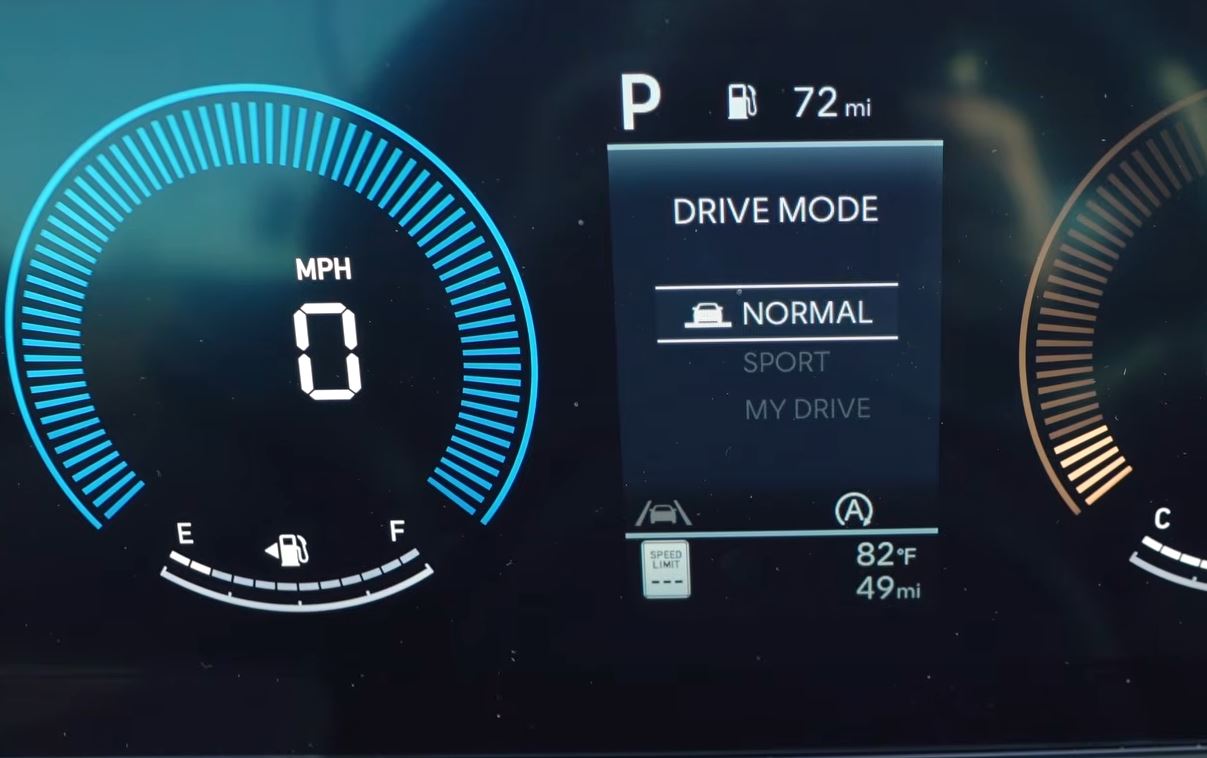
If you’ve driven a gas Tucson or read older reviews, you might be looking for Normal. On the Tucson Hybrid, it isn’t there. Eco takes its place as the everyday, default setting.
The gas-only Tucson lists a Normal mode alongside Eco, Sport and Smart, which is likely where the mix-up comes from. On the hybrid, Hyundai seems to treat Eco as the baseline because the hybrid system is already tuned for efficiency.
When did this change? I haven’t been able to pin down an exact model year. The hybrid appears to have shipped with Eco as its default from the 2022 launch, so it may be a hybrid-versus-gas difference rather than a year-to-year change.
Owners of 2026 hybrids report seeing Sport, Eco and My Drive on the screen, with no Normal. Check your owner’s manual for your exact year.
Eco: Where My Tucson Lives Most of the Time
I’ll be honest. I almost always drive in Eco.
Since there’s no Normal on the hybrid, Eco is the balanced, do-everything setting. Throttle response is predictable, the hybrid system switches between electric and gas on its own, and the transmission shifts like a regular 6-speed automatic.
Here’s what Eco does, based on the owner’s manual and how the car feels:
- Calmer throttle response, so the car doesn’t lurch on small pedal inputs
- Earlier upshifts to keep engine RPM low
- More willingness to stay in electric mode at low speeds
- Climate control may run a bit less aggressively
Myth worth correcting: Eco on the Tucson Hybrid isn’t a penalty mode you only use when you’re desperate for fuel. It’s the default calibration.
It also doesn’t add a magic fuel-saving feature. Mostly it encourages you to drive gentler. If you’re getting close to empty, a light foot does more than any button.
Searching “is Eco better than Normal”? On the hybrid, that comparison doesn’t apply, because Eco is the normal mode. The car already runs on electric power at low speeds whenever the battery has charge, so you’re getting the hybrid benefit without doing anything.
For a long road trip, like the five-hour drives people ask about, Eco with cruise control is the way to go. The difference between modes on the highway shrinks a lot anyway.
Merging onto a busy highway in Eco can feel a little soft. If you need more response in that moment, just press the pedal further or tap Sport.
Sport: The Empty-Road Mode
Now the fun one.
I use Sport at certain moments, usually when I’m driving alone and the road is clear. Sometimes I just want to feel what the Tucson can really do.
So what does Sport actually change?
- Sharper throttle mapping, so the car reacts faster to small pedal inputs
- The transmission holds gears longer and downshifts sooner
- The gas engine runs more often and the electric motor adds boost more eagerly
- Steering gets heavier
- The cluster switches to a red, sportier theme
Does Sport give you more power? Not really. Total system output stays the same in every mode: roughly 226 hp for 2022-2024 and around 231 hp for the 2025 refresh, according to Hyundai’s spec pages.
What Sport does is give you that power sooner. That’s why it feels quicker off the line. The 0-60 time doesn’t change much, but the car feels more awake from the first press of the pedal.
Does Sport use more gas? Yes. The engine runs more and the car stays in lower gears. If you drive in Sport all day, expect your mpg to drop below the EPA rating. For reference, the EPA lists the 2022 Tucson Hybrid Blue at about 38 mpg combined and the other trims at about 37.
On a 2022 SEL, does Sport give you more efficiency than Eco? No. That one’s not close.
Smart: The Mode That Switches on Its Own
Lots of owners search “will my Tucson switch drive modes on its own?” The answer is yes, but only in Smart mode.
Smart watches how you drive and picks between Eco and Sport behavior automatically. Drive gently and it leans Eco. Get aggressive with the throttle on a twisty road and it shifts toward Sport.
Is the Tucson always in Smart mode? No. The car remembers your last selection or defaults to a set mode on startup, depending on the year. If your screen says Sport, Eco or My Drive, you’re in that mode, not Smart.
My opinion: Smart is fine if you never want to think about it. I prefer picking the mode myself, because Smart sometimes guesses wrong on a quick merge.
My Drive (2025 and Newer)
On the refreshed 2025-2026 Tucson, My Drive lets you build your own custom mode. You mix and match settings for throttle, steering and powertrain response.
Some owners see a setting with levels like 1 to 6 on the screen. That’s most likely an adjustment within My Drive, such as regenerative braking strength or response level.
If you like Sport’s steering but want Eco’s calmer throttle, My Drive is how you get that combo.
Baby Mode: The One That Surprised Me
This one caught my attention. There’s a Baby mode on the Tucson, and I think it’s a great fit for beginner drivers.
From what I’ve seen, it calms the car down so it doesn’t jump forward when a nervous new driver presses the pedal.
Eco vs Baby mode: Eco is built to save fuel. Baby mode is built around a gentle, forgiving feel for an inexperienced driver. If you’re teaching a teenager to drive, I’d start them in Baby mode.
Snow, Mud, Sand: The AWD Terrain Modes
These are separate from the normal drive modes on most HTRAC-equipped Tucsons. They adjust how power is split between the axles and how the traction control reacts.
- Snow: Softens throttle and sends power more evenly to reduce wheelspin
- Mud: Allows some wheelspin to keep momentum
- Sand: Holds revs higher to avoid bogging down
Does Snow mode hurt fuel economy? Slightly, because it sends more power to the rear wheels more often. It’s not worth worrying about. Use it when there’s snow on the ground and switch it off when the roads are clear.
Remember, a terrain mode can’t fix bad tires. Good winter tires matter more than any button. If winter driving is your main worry, check out my list of the best SUVs for snow.
Plug-In Hybrid Owners: EV and HEV Are a Different Thing
If you have the Tucson PHEV, you’ve got an extra layer that confuses a lot of people.
- EV mode: Runs on battery power only, as long as there’s charge and you don’t floor it
- HEV mode: Works like the regular hybrid, mixing gas and electric
- Auto EV/HEV: The car decides for you
These sit on top of Eco/Sport. You can be in EV mode and Sport at the same time.
Want to save battery for city driving later? Switch to HEV on the highway, then go back to EV in town. That’s the smartest way to drive a Tucson PHEV.
Can you drive it “petrol only,” as UK owners ask? Not fully. HEV mode leans on the engine, but the electric motor still helps out. And no, the PHEV doesn’t offer true one-pedal driving the way some EVs do, though paddle-adjustable regen gets you partway there.
If you’re still deciding between hybrid and plug-in, my best PHEV SUV guide puts the Tucson up against its rivals.
Things on the Dash That Aren’t Drive Modes
These come up constantly in searches, so here’s the quick version.
The green “EV” light: That just means you’re running on electric power right now. It isn’t a mode you selected. You’ll see it come and go during everyday driving.
Utility mode: On newer Hyundai hybrids, this lets you run the climate control and electronics for long periods while parked, using the hybrid battery and engine as needed. It’s handy for camping or waiting in the car.
Stay mode: This is a Hyundai camping-style feature in some markets. Availability on US Tucson Hybrids is unclear.
Accessory mode: This is the ignition position that powers the radio and outlets without turning on the hybrid system. It’s not a drive mode at all.
“Why does my hybrid act like it’s in Sport mode when it’s cold?” It’s not switching modes. In cold weather, the gas engine runs more often to warm the cabin and itself up. That can feel like higher RPM. It’s normal.
“Can the Tucson Hybrid change lanes on its own?” That’s a driver-assist question, not a drive mode one. Highway Driving Assist on certain trims can help with lane changes when you use the turn signal.
Which Mode Fits Your Driving?
Here’s my straight verdict by driver type:
- Daily commuter, mixed roads: Eco. It’s the default for a reason, and the hybrid does the work.
- Mostly city, stop-and-go: Eco. The car runs electric a lot at low speeds.
- Long highway road trip: Eco with cruise control.
- Low on fuel, nowhere to stop yet: Stay in Eco and use a light foot.
- Empty back road, alone, feeling it: Sport. That’s what it’s there for.
- Teaching a new driver: Baby mode.
- Snowy roads, AWD model: Snow terrain mode plus proper winter tires.
- Never want to think about it: Smart.
Does the drive mode button make a difference at all? Yes, but it’s mostly about feel. Your fuel economy depends far more on how you drive and the weather than on which button you press.
Is fuel economy the reason you bought the hybrid? Here’s how the Tucson stacks up in my most fuel-efficient hybrid SUV roundup.
What I Would Do
If you just bought a Tucson Hybrid, leave it in Eco and forget about it for a few weeks. Don’t go hunting for Normal, because Eco is the everyday mode on the hybrid.
Learn how the car behaves. And when you get a clear road with nobody else in the car, tap Sport and enjoy it.
That’s when this SUV feels most alive to me. Got a new driver in the family? Try Baby mode first.
Which mode do you leave your Tucson in? Have you noticed a real MPG difference between Eco and Sport? Tell me in the comments, along with your model year and trim. I’d love to compare notes.